The problem
Physics-informed neural networks promise simulation without a mesh: a network is trained until it satisfies the governing equations at a set of points. In practice training is slow, needs careful tuning, and often fails to converge, even on linear problems. Despite years of interest, that has kept these models in proof-of-concept papers rather than in reservoir engineering workflows.
The idea
Two things make the training problem nonconvex. One is the physics: the equations of multiphase flow are nonlinear. The other is the network: its nested activation functions make the loss nonconvex even when the equation is linear.
LiL-Q removes both. Bellman–Kalaba quasilinearization replaces the nonlinear equation with a sequence of linear ones, each linearized about the current solution. A trial space that is linear in its trainable coefficients, such as spectral polynomial and trigonometric bases or random-feature networks, then turns each linear problem into a least-squares problem, solved directly by one QR factorization instead of thousands of gradient steps. Comparing all four combinations of network or linear trial space, with or without quasilinearization, showed that removing only one source of nonlinearity is not enough.
What it showed
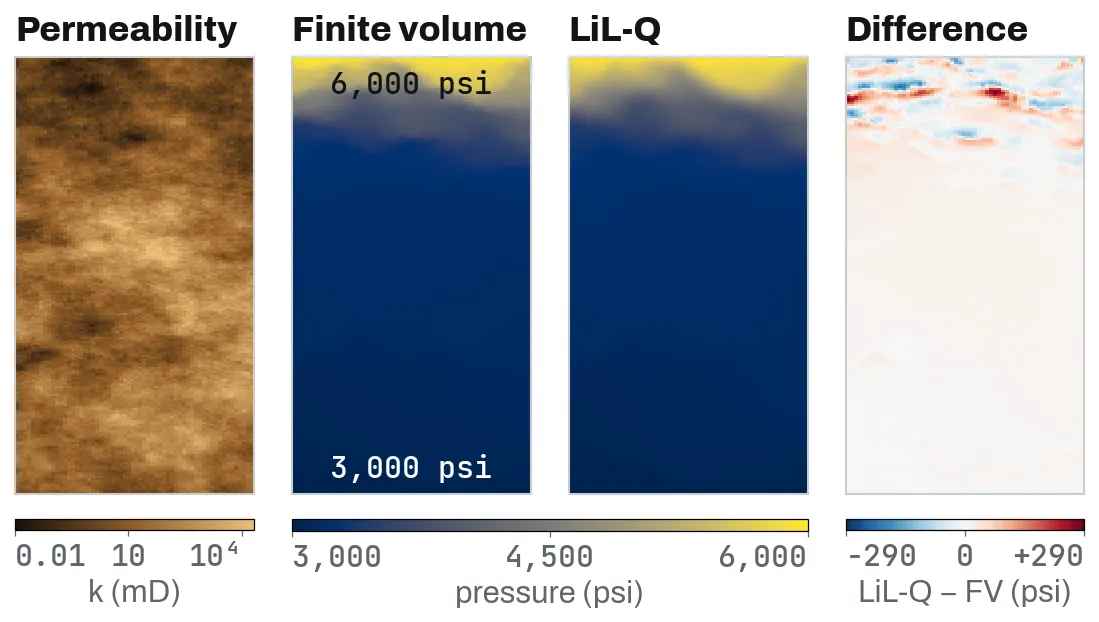
We tested LiL-Q on seven problems: the Bratu, Burgers and Buckley–Leverett equations, Kovasznay flow, 3D unsteady Beltrami flow, linear elasticity, and Darcy flow on SPE10 permeability. It converged in single-digit outer iterations at all but the coarsest basis sizes, with runtimes up to three orders of magnitude shorter than standard training. On the Navier–Stokes benchmarks it matched published solvers with up to two orders of magnitude fewer parameters, and it recovered the elasticity solution to machine precision.
Where it stands
Learned solvers have to be judged against the classical methods engineers already use. On the SPE10 pressure problem LiL-Q took about 24 seconds where a standard physics-informed network took about 1,600, but a finite-volume solver took about a tenth of a second. Closing that gap, with bases that keep the least-squares systems sparse, and handling fully coupled pressure and saturation are the open problems our ECMOR 2026 paper sets out.
Papers and code
LiL-Q was my M.S. thesis at Texas A&M, defended in June 2026. The methods paper is on arXiv, the reservoir application is in the ECMOR 2026 proceedings, and I presented the work at AESCAPE 2026 in Dallas. The code is open source as lilq-pinn, with a guide to reproduce every result.